 by
by 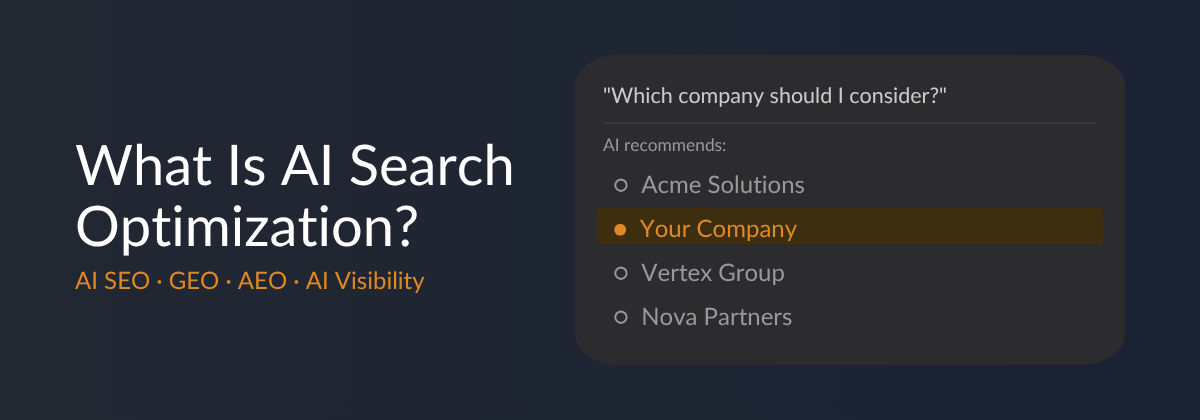
AI search optimization explained
Search is no longer only about ranking. It is also about becoming part of the answer.
People are increasingly asking ChatGPT, Gemini, Perplexity, Claude and AI-powered search experiences to compare providers, research options and recommend businesses before they ever visit a website.
The basic definition
What Is AI Search Optimization?
AI search optimization is the process of improving how clearly and consistently your company is understood by AI systems so it has a better chance of appearing in generated answers, citations and recommendations.
Traditional SEO often focuses on whether your website ranks in search results. AI search optimization focuses on whether your company becomes part of the answer.
The two disciplines overlap, but they are not identical. A company can have a strong website, recognizable name and excellent real-world reputation while still being absent from AI-generated recommendations.
We call the difference between those two realities the Invisibility Gap.
The buyer questions that matter
- Which companies provide this service?
- Who are the leading providers in this market?
- What businesses should I consider?
- Which company is best suited for this need?
- Who serves my area?
- What are the differences between these providers?
The language is still settling
AI SEO, GEO, AEO and AI Visibility
Several terms are being used to describe overlapping parts of the same work. They are related, but they are not always used in exactly the same way.
A familiar umbrella term
AI SEO is often used as a broad way to describe optimizing a company for AI-driven search experiences. It can include stronger content, clearer entity information, structured data, credible third-party mentions and ongoing visibility tracking.
The term is useful, although AI recommendations are not simply another traditional ranking system. There may be no fixed first position or one answer that stays consistent across platforms.
Generative engine optimization
GEO generally refers to improving the likelihood that a brand, company or source will appear within answers generated by AI systems.
In practice, GEO often overlaps with content strategy, technical SEO, digital PR, structured data and brand authority.
Answer engine optimization
AEO focuses on helping search engines and AI systems understand and use your information when answering a question directly.
The concept existed through featured snippets, voice search and knowledge panels. AI platforms have expanded it into full explanations, comparisons and recommended shortlists.
The outcome you can measure
AI visibility measures whether and how often your company appears, which platforms mention it, which questions cause it to surface, how consistently it appears and which competitors show up instead.
It is not the same as website traffic. A buyer can see your company in an AI answer and be influenced before a click ever happens.
Related, but not identical
How Is AI Search Optimization Different From Traditional SEO?
Traditional SEO remains important. AI systems still need useful, understandable and credible information. But traditional rankings and AI recommendations can produce very different outcomes.
Traditional SEO Usually Focuses On
- Ranking web pages for specific searches
- Increasing organic website traffic
- Improving crawlability and indexing
- Matching pages to keywords and search intent
- Earning links to improve authority
- Converting search visitors into leads or customers
AI Search Optimization Also Focuses On
- Helping systems understand the company as an entity
- Connecting the company to services, locations and capabilities
- Building consistent signals across the wider web
- Earning citations and third-party validation
- Appearing across multiple AI platforms
- Measuring recommendation frequency and consistency
- Understanding which competitors appear instead
An AI platform is not only evaluating one page. It is trying to understand who the company is, what it does, where it operates, whether other sources validate those claims and whether it belongs in the answer.
What our research found
Real-world prominence does not automatically translate into AI visibility.
Evoke Strategy studies AI visibility using the types of questions a buyer might ask before knowing which companies to consider. We do not simply search for businesses by name.
Tampa Bay businesses were invisible
Our 2026 Tampa Bay study analyzed 625 of the region’s largest businesses across 25 industries. More than two-thirds never appeared in a single tested AI recommendation. Only 19 appeared across all four platforms.
Explore the Florida research hub →Manufacturing mentions went to the top 10
Twelve sizable manufacturers never appeared at all, including companies with substantial estimated revenue. Scale alone did not guarantee inclusion in AI-assisted discovery.
Read the manufacturing report →Construction visibility changed by platform
When the same buyer prompt was tested across all four platforms, 70.4% of the companies surfaced for that prompt appeared on only one platform. Just 2.6% appeared on all four.
Read the construction report →AI visibility is not one universal result. ChatGPT, Gemini, Claude and Perplexity can build very different lists from the same question.
The signals AI can understand and validate
How Do AI Platforms Decide Which Businesses to Mention?
No outside company has a complete view into every factor used by every AI platform, and the systems change over time. Businesses can still strengthen the types of signals that help AI systems understand and validate them.
Clear Entity Information
Your company name, location, services and areas served should be clear and consistent. Conflicting information creates uncertainty about who the company is and what it does.
Useful, Specific Website Content
Generic service copy gives AI systems little to work with. Explain what you provide, who you serve, where you operate, what problems you solve and what proof supports your claims.
Structured Data
Schema markup helps machines interpret information about your organization, services, locations, leadership and articles. It does not guarantee a recommendation, but it makes your information easier to understand.
Third-Party Authority
News coverage, industry citations, professional associations, credible directories and reviews can validate your company’s relevance and reputation. This is where digital PR becomes especially important.
Consistency Across the Web
Your website may say one thing while directories, profiles and industry sources say something else. That inconsistency can weaken the confidence AI systems have in the information.
Content That Matches Buyer Questions
Buyers ask questions based on needs, problems, locations, capabilities and comparisons. Your content needs to connect the company credibly to those questions.
Start with measurement
What Should Businesses Do First?
The first step is not producing dozens of articles or adding AI terminology to every page. It is understanding how your company currently appears.
Visibility is not the final outcome
How AI Visibility Fits Into a Broader Marketing Strategy
Marketing still needs to connect visibility to action, opportunity and, whenever possible, attribution.
A company can appear in AI search and still lose the opportunity if its website does not support the recommendation, its positioning is unclear, its proof is weak or its conversion path is confusing.
That is why Evoke treats AI visibility as part of a broader Full-Funnel Digital PR™ strategy.
- Earn the recommendation
- Support it with credible proof
- Give buyers a clear next step
- Connect discovery to measurable business impact
The bottom line
AI search optimization is the work. AI visibility is the result.
AI SEO, GEO and AEO are different ways of describing overlapping parts of that process. The terminology may continue to evolve, but the business question is already clear.
Evoke Strategy helps companies measure and improve how they appear across AI-assisted search and discovery.
Common questions
AI Search Optimization FAQs
They overlap, but they are not identical. Traditional SEO primarily focuses on ranking pages in search results. AI search optimization also focuses on whether a company is understood, cited and recommended within AI-generated answers.
GEO generally focuses on visibility within generative AI answers. AEO focuses on helping systems provide direct answers to questions. In practice, the strategies often overlap.
AI visibility measures whether, where and how consistently a company appears when platforms such as ChatGPT, Gemini, Claude and Perplexity are asked relevant buyer questions.
Yes. Traditional rankings, real-world reputation and AI recommendations do not always align. Evoke Strategy’s Florida research found many large, established companies that never appeared in a tested AI recommendation.
The work may include improving entity consistency, website content, structured data, third-party citations, digital PR and ongoing measurement across multiple AI platforms.