 by
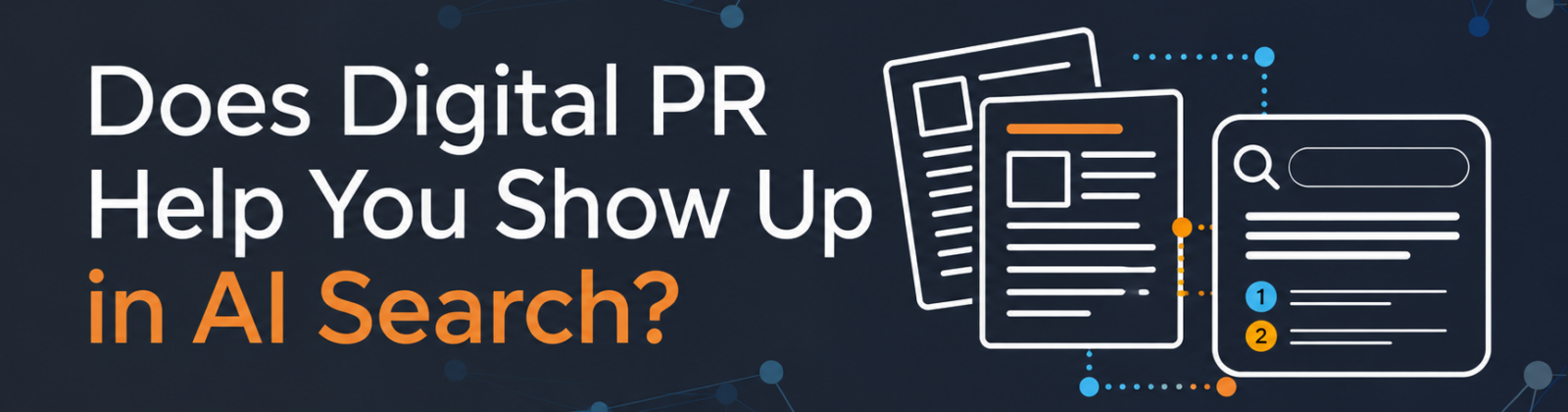
As more businesses pay attention to ChatGPT, Google AI Overviews and other AI search tools, a reasonable question is starting to come up: does public relations help a company get recommended?
It can help. But there is a difference between building a credible public record that AI systems may use and buying a predictable place in an AI answer. Any agency promising that a few press mentions will reliably put your business in ChatGPT is skipping several important steps.
What Digital PR Can Contribute
Traditional PR earns attention. Digital PR can also make the evidence behind a business easier to find and verify online. A reported article, expert interview, industry study or independent mention may explain what a company does, who it serves and why its expertise is relevant.
That information has value beyond one media placement. Buyers can encounter it directly. Search engines may discover and rank it. Some AI search systems retrieve and cite third-party pages when they build an answer. Others work differently, and none is obliged to recommend the company simply because a publisher mentioned it.
The practical opportunity is to make the company’s important claims easier for people and machines to corroborate. An earned article about a specific capability usually does more to explain that capability than a generic announcement that a business exists.
What Our Florida Research Does, and Doesn’t, Prove
In our 2026 Florida AI visibility study, we benchmarked 28,488 businesses across nine cities and 18 industries. Only 5.9% appeared at least once in the recommendation searches we tested. Even among businesses that appeared, results varied by platform and by how we described the buyer’s need.
One finding was especially revealing: 37.4% of the businesses confirmed in specific-need searches had not appeared in either of the two broader search types. A business could be missing from a general recommendation but appear when a buyer described the exact work they needed.
That tells us something about discoverability. It does not establish that PR coverage caused the appearances. Our study was a point-in-time recommendation benchmark, not a controlled experiment comparing businesses with and without earned media.
We also received independent coverage of the research. That is evidence that the story was useful to editors and audiences, not proof that the coverage changed how an AI platform ranked or recommended Evoke. Those are separate questions, and they deserve separate measurement.
PR Is One Part of the Information a Buyer Finds
Imagine a buyer looking for a specialist manufacturer, contractor or financial services firm. The company website needs to explain the service and market clearly. Technical search fundamentals help the information remain accessible. Case studies give substance to the claims. Relevant third-party coverage can provide independent context.
Those pieces reinforce one another, but they don’t do the same job. A press article cannot rescue a confusing service page. Schema markup cannot manufacture external credibility. A backlink alone is not evidence that an AI system will name the business. The useful question is whether the complete public record makes the company understandable and worth considering.
This is why we approach digital PR, content, search and AI search visibility as related disciplines rather than separate promises.
How We’d Measure Whether the Work Is Helping
If AI discovery is an objective for a digital PR engagement, we’d establish the baseline before pitching a story. At minimum, that means checking questions real buyers might ask, who gets recommended, what sources the tools cite, and how consistently the result appears across platforms.
- Track buyer-question coverage. Use a fixed group of realistic unbranded questions, not one flattering prompt.
- Track cited sources and competitor context. A brand mention and a citation to a publisher are different observations. Record both.
- Track the earned footprint. Note which credible articles, interviews and references explain the business’s priority capabilities.
- Track normal search and business outcomes. Look for relevant branded discovery, referral visits, qualified inquiries and useful sales conversations, without assigning every change to PR. Our analysis of AI referral traffic and B2B shortlists explains why clicks alone can miss part of the buyer journey.
- Repeat consistently. Hold prompts, locations, platforms and measurement methods as steady as possible, and document changes outside your control.
Even with a careful baseline, correlation isn’t causation. Search algorithms, retrieval sources, models and competitors change. A small company won’t have enough data to make a strong causal claim from a single coverage cycle.
What to Ask an Agency That Promises AI Visibility Through PR
I’d ask three questions. What specific buyer questions are we trying to influence? What credible new information will this campaign put into the world? And how will we tell the difference between getting mentioned, getting cited and creating a real business opportunity?
Good answers should be specific to the company, its market and the people it needs to reach. They should also acknowledge that earned coverage and AI recommendations cannot be guaranteed.
A More Useful Place to Start
Before investing in a new campaign, look at how buyers might discover the business today. Test a small, repeatable set of questions, compare the competitors that appear and inspect the independent sources behind those answers. Then decide whether the gap is unclear website information, weak third-party evidence, limited topical coverage or something else.
Sometimes the next move is media outreach. Sometimes it’s improving a service page or documenting work the company already does well. Usually it’s a combination, sequenced around the business objective.
If you’d like to understand where PR, search and AI discovery fit together for your organization, start a conversation with Evoke Strategy. We can help identify what is worth investigating before recommending a campaign.